The Lost Gospel
The Lost Gospel is a speculative and immersive exhibition that reimagines Western history through the discovery of a suppressed Gnostic text—the Gospel of Annath—in the Nag Hammadi library. The exhibition constructs an alternate theological and artistic timeline where God’s death, as narrated in this “lost gospel,” prevents the rise of Christianity. In this world, classical Greek philosophy becomes the foundation of unified dogma under Constantine, with Socrates replacing Christ as the central moral and symbolic figure.
While historical events are contingent, the human need for foundational myth and sacred symbolism is inevitable. The forms change, but the deep structure persists.

Centered in a stark, minimalist gallery space rests a single, monumental jar. Its form is instantly familiar—the rounded shoulder, narrow neck, and wide mouth directly reference the ancient Coptic jars discovered at Nag Hammadi, Egypt, which once contained the Gnostic codices.
Yet, the material betrays its true nature. The vessel is not crafted from terracotta or clay, but from a matte, pale-grey composite resin, 3D-printed in seamless layers. The surface perfectly mimics the gritty, irregular texture of fired earth, even down to the subtle imitation of weathering and hairline cracks. It is a meticulous replica, a ghost made through contemporary means.
Isolated on a low, neutral plinth under precise, cool lighting, the jar exists in a state of potent paradox. It is an artifact of a hypothetical past, physically present yet conceptually fictional. It does not house lost gospels, but the very idea of loss and discovery itself. Its presence in the white cube of the contemporary gallery questions what we preserve, how we replicate history, and the vessels we construct to hold our alternative narratives.


Displayed like a holy relic in the center of a hushed, cavernous room is a single, massive book. Its scale is intimidating, reminiscent of a medieval pulpit Bible meant to signify absolute authority. It lies open beneath a sealed, flawless crystal vitrine, its pages frozen in a silent proclamation.
The object is a masterpiece of synthetic simulacra. Its cover is a deep burgundy plastic, textured and grained to perfectly imitate aged, tooled leather. The pages are a stark, bright white composite paper-substitute, their edges gilded with cheap, reflective foil that catches the light. The text—visible but deliberately blurred to the viewer—is not scripture, but dense, classical Greek philosophy typeset in the solemn, columnar style of a holy book.

A detailed ceramic sculpture depicts the pivotal moment where bishops and theologians, absent a Christian framework, deliberate. Their decision to adopt Greek philosophy as the pillar of state-sanctioned belief is captured in tense, figurative form.

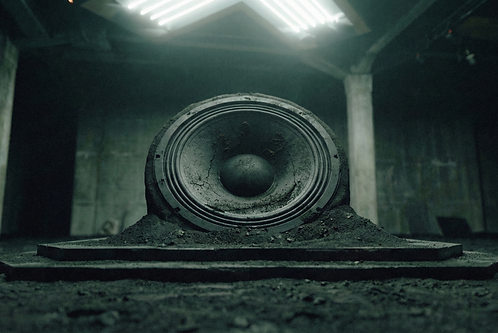
Room 4: Axiom
The room is a vessel for silence. In a darkness so complete it feels like pressure, the only form that emerges is a matte-black monolithic speaker—an altar built for a sound that never comes. Beneath it, the floor disappears into a deep expanse of fine black sand, a terrain that absorbs every footfall, every rustle, into pure, mute stillness. The space hums not with noise, but with the subsonic frequency of an accepted truth, a foundational consensus that has passed beyond the need for words. This is the silent bedrock of dogma: the point where argument ends, and doctrine begins, buried in the dark and waiting to be heard.

The work is an anonymous, life-sized sculptural group that immediately echoes the serene composition of a classical marble frieze or a Renaissance Last Supper. Yet its material betrays its true nature: it is carved not from stone, but from a dense, pigmented polymer composite, expertly finished to simulate the cool gleam and subtle veining of Carrara marble. Upon closer inspection, the surface reveals a faint, uniform porosity—the telltale signature of a synthetic cast.

The Athenian Supper by Caravaggio

The School of Socrates by Raphael

Socrates and Plato: The Origin of Thought by Michelangelo