Psychotronic
The exhibition operates on the premise that some patterns in the world are real but transient. They exist long enough to be intersubjectively verified—“Did you see that?”—but not long enough to be measured, catalogued, or owned. They are shaped by physics and perceived through shared cognitive biases, occupying a profound middle ground between subjective hallucination and objective fact.
A Reality That Flickers — The World Is Full of Things That Almost Exist.

Installation: A Lens of Mass
A dense black stone hangs above a floor of shadow. It does not rest—it warps. The space around it bends, a slow, gravitational flicker in the field of the room. Here, mass is not just matter; it is a momentary distortion of time, a reality that gathers and threatens to dissolve. You witness not an object, but an event—a stable instability. The rock is always almost falling, and time is always almost still.

Room 2: Cymatic Witness
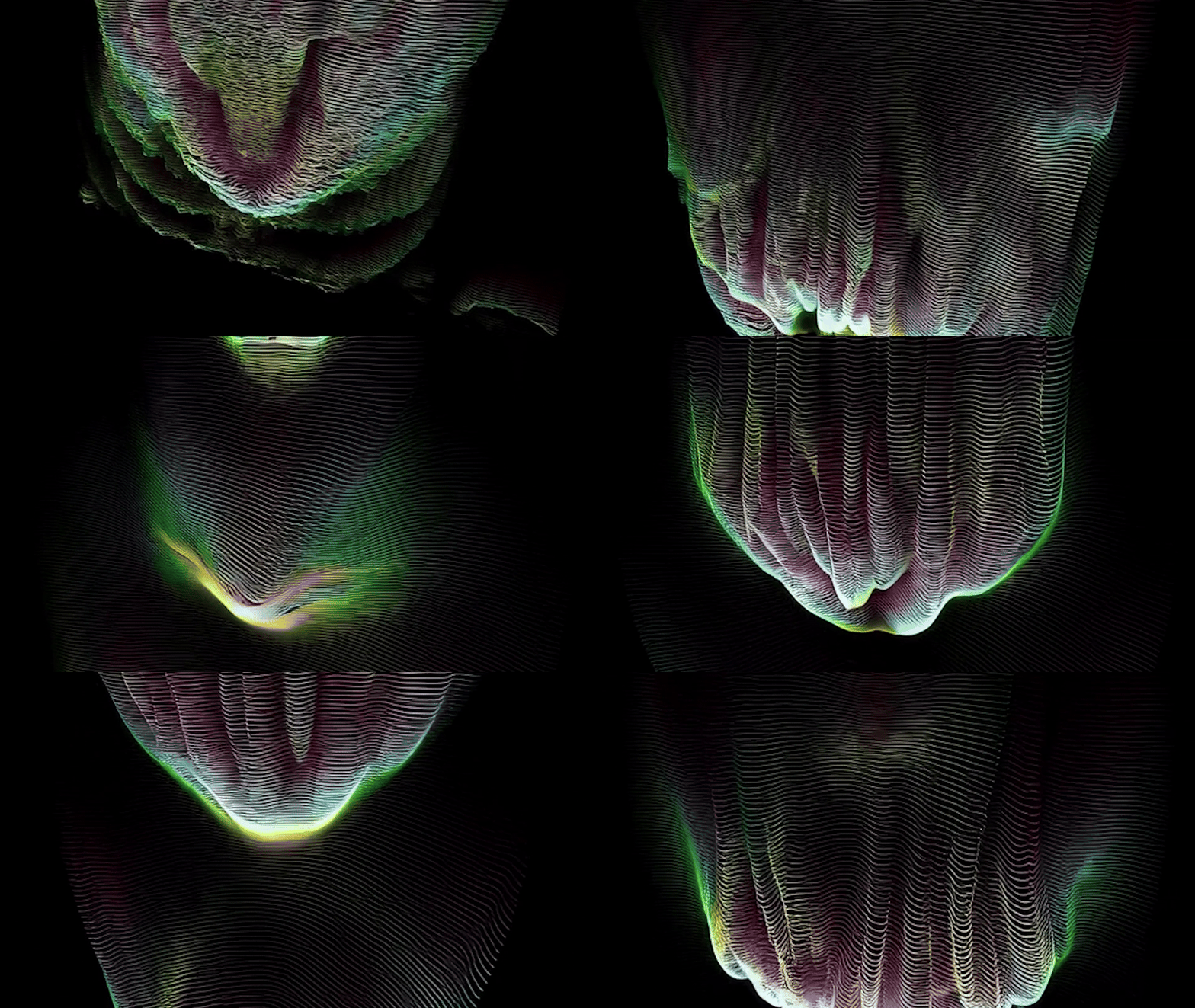
Floor-to-ceiling screens glow with the real-time translation of microwave radiation—invisible energy made visible as a rippling, shimmering field of grayscale waves. This is not simulation, but mediation: the electromagnetic chatter of the room itself, of distant satellites and hidden Wi-Fi, rendered as a living, breathing textile of interference.
The patterns are in constant emergence. Waves coalesce into near-forms—a shuddering vortex, a brief lattice, a pulse that resembles a face—before dissolving back into noise. The space thrums with a sound just below hearing, a physical resonance tuned to the displayed oscillations.
Room 4: Non-Local Contact
A stark, 1960s government interview room. On a monitor, a grainy film loop shows a flickering, humanoid entity being questioned. Its voice is layered and calm, describing its existence not in terms of distance, but of quantum superposition: “I am a state, not a place. You do not find me; our mutual observation briefly holds me here.”
The interview itself appears to be the stabilizing event—the act of witness that momentarily collapses a possibility into a shared reality. As you watch, the signal glitches, threatening to dissolve. This room poses the ultimate question of the exhibition: are we making contact, or are we collaboratively manifesting a transient reality from the non-local field of the universe? The alien is not an arrival, but an agreement.


Room 4: Unidentified Aerial Phenomena (Study in Stabilization)
Four pristine, monumental crystal vitrines stand in a stark, white gallery space. Inside them, the subject is presented with the clinical detachment of a natural history museum or a high-art installation.
Two of the boxes contain physical objects: minimalist, polished metal forms—one a smooth, asymmetrical ovoid, the other a sharp, angular shape of unknown purpose. They are inert, heavy, and final. They represent the UAP as captured artifact, the phenomenon stabilized into a permanent, debatable object. They are answers waiting for a question.
The other two boxes appear empty at first glance. Then, with a soft hum, a hologram flickers to life within each: a shimmering, rotating light-form, a classic “Tic-Tac” or a spinning disc. These are not solid. They glitch, dissolve, and re-form in a loop. They represent the UAP as witnessed event—the elusive, perceptual pattern that cannot be pinned down, only experienced.
Together, the quartet stages the central drama of the exhibition. It confronts the gap between the stable object we can archive and argue over, and the unstable event we can only collectively recall. It asks: is the truth of the phenomenon in the hard, cold metal, or in the immaterial, flickering light? Is reality the thing that persists, or the pattern that haunts? The room offers both, sealed under glass, forever separating and forever linking the tangible and the transient.